


Our experience making Oriental Beauty tea in Emei: tradition, craftsmanship, and the unique flavor of Taiwan

Updated: Nov 4, 2025
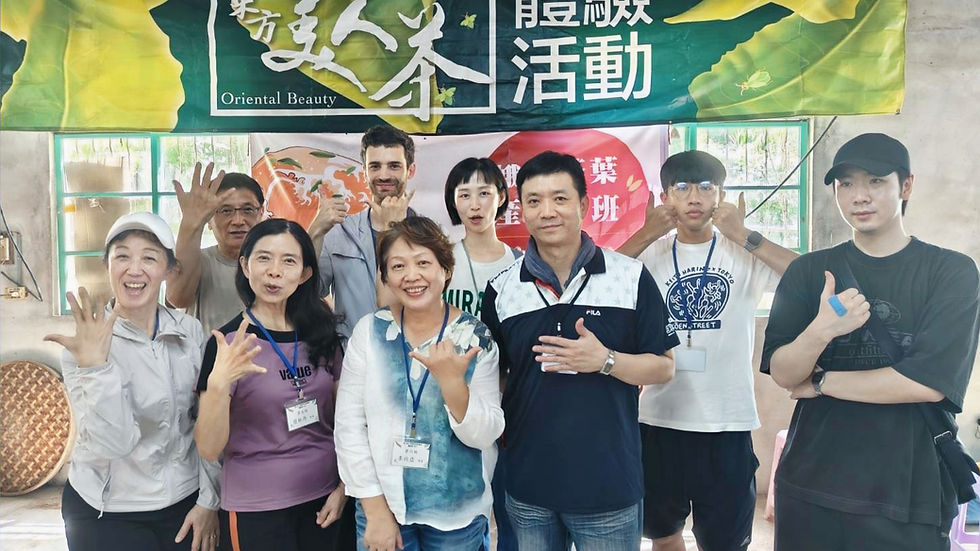
A few weeks ago, Iris and I had the chance to participate for the second time in a two-day workshop in Emei, Hsinchu, organized by the local Farmers' Association. There, we learned how to handcraft one of the world's most famous teas: Oriental Beauty Tea (Dong Fang Mei Ren). We also took part in this workshop a year ago, and it was so good that we decided to repeat it this year!
This unique tea stands out not only for its honey and ripe fruit aromas but also for its rich history. Its special character comes from a small insect, the Jacobiasca formosana, which, when it bites the leaves, triggers a natural process in the plants that gives rise to its unmistakable aromatic profile.
During the workshop, we experienced each stage firsthand: the careful harvesting of tender shoots, sun-withering, controlled fermentation, fixation, and drying. Working alongside Emei's masters allowed us to understand the level of detail, patience, and respect for nature that this tea requires.
Emei is not just a town known for its tea production; it's one of the cultural hearts of Oriental Beauty, where generations of farmers have preserved this tradition. For us, as Co-Founders of Yang Tea, this experience was transformative. Each opportunity helps us understand that what we share with the world is not just a product but also a story of dedication and a living culture.
Index of this article
Why is Oriental Beauty tea so special? Let's talk about its history!
Oriental Beauty Tea Making Workshop in Emei: Maintaining Traditions
The workshop...
Oriental Beauty Tea Processing
What did we learn during the workshop?
Would you like to try the Oriental Beauty of this town?
Final reflection: between tradition and modern market
Why is Oriental Beauty tea so special? Let's talk about its history!
Let's first analyze the origin of its name
"Oriental Beauty"—you've probably heard it before. Its name comes from a contemporary legend. Stories tell that Queen Victoria, upon drinking this tea for the first time, liked it so much that she named it "Oriental Beauty" for its delicate honey and floral aromas. There are no historical records of this event, so it's mostly a nice legend that gives this tea its fame.
But, legend or not, surely the first people in Europe who were dazzled by its aromatic profile must have thought something similar. Its name has a basis. It truly is a beautiful tea from the East!
Over time, it has gained other nicknames, such as Champagne Oolong, White Tip Oolong, and 5 Colors Tea. These last two names are derived from the color of its dried leaves, which have a silvery bud (due to its abundant trichomes) along with brown, reddish, green, and yellow leaves.
Other local names used in Taiwan are 'Dong Mei', abbreviating the common name Dong Fang Mei Ren 東方美人, or PomFong Thé, among others.
Now, what makes this tea so special?
Let's continue with its story to find out... Another legend tells that Hakka communities in northern Taiwan used to make tea even when it had been "attacked" by pests, something that other immigrants, like the Han ethnic group, didn't like. But there was one particular "pest" that "attacked" the plantations of a relatively large producer. According to legend, they didn't want to lose that season's production, so they decided to continue processing it.
This gave way to 'Oriental Beauty' tea, which was later exported and gained the fame we now know. So we see how once again, an apparent catastrophe gave way to a world-renowned tea. Specifically, it's a tiny grasshopper that triggers defensive reactions in tea plants by sucking on the surface of their leaves. Once this insect, called Jacobiasca Formosana, pierces the leaves, the plant releases a substance (linalool) that gives the tea a honey-like aroma. This substance is a defensive mechanism that attracts the small grasshopper's predator.
But the piercing of this insect is only the first step, one of the many ingredients that have to conspire to create a good Dong Fang Mei Ren. Keep reading, and I'll tell you what they taught us at the Emei Farmers Association.
Oriental Beauty Tea Making Workshop in Emei: Maintaining Traditions
The workshop...
The Emei Farmers Association in Hsinchu brings together farmers specializing in the production and cultivation of Oriental Beauty tea. This is one of the first areas to produce this type of tea, and this edition was organized by one of the first families in all of Taiwan to produce Oriental Beauty.

The workshop teachers are renowned Oriental Beauty masters who have won top awards in competitions and/or come from families with several generations of history in the Dong Fang Mei Ren industry.
In the two-day workshop, we learned how to perform each step of the process with our own hands, starting early in the morning on day one and finishing at dawn. The next day, we gathered to taste each and every tea sample we made. In total, there were 15 groups, so we compared each sample, and the judges ranked them according to quality (of course, we're a far cry from the teas these masters make!).
Oriental Beauty Tea Processing
Let's review the Oriental Beauty process so you have an idea of what we did on day one:
Harvest:
Of course, each tea begins with the harvesting of the leaves of our beloved Camellia. In the case of Oriental Beauty, we harvest the tender buds and 1 or 2 open leaves. The type of plant (cultivar) is also important. Traditionally, the QingXin DaPan cultivar is harvested for this type of tea, but nowadays, other cultivars are also used, such as TTES#12 or TTES#17, to name a few.
QingXin DaPan QingXin DaPan QingXin DaPan QingXin DaPan
Something relevant is that for this workshop, we used autumn leaves, a sort of "inter-seasons" harvest, whose quality is inferior and out of the season of Jacobiascas Formosana. During the main seasons, the masters are busy producing their precious tea. For the purposes of this workshop, the harvest ended the day before our arrival, during the afternoon.
Withering
After spending the afternoon before our arrival and all night withering under the shade, we proceeded to place the leaves on bamboo trays to wither them under the sunlight. As you'll see in the next section ("What did we learn during the workshop?"), withering plays a tremendously important role in tea making.
In the case of Oriental Beauty, we seek to produce a medium-high oxidized tea, so the withering time is intended to release moisture from the leaves so that they are elastic enough for the following steps.
But not only that, during the withering process, many things happen. The aromas of the leaves also transform... little by little, floral aromas begin to develop! Every few hours, to facilitate the release of moisture, we stir the leaves very gently (see the video and photo gallery below). If we use rough movements, especially at the beginning, we can bruise the leaves! If this happens, the moisture won't be able to come out, and they will rot. This is perhaps one of the most common defects in tea.
It's difficult to give a fixed recipe for making tea since it depends on countless factors, but I can tell you that the wilting in this particular case lasted just over 24 hours from the time the leaves were harvested. The ideal point to finish with wilting will be determined by the experience of the tea master and, of course, the type of tea we are making.
Shaking/Tumbling
Once the ideal withering level has been reached, we'll need to oxidize the leaves until they reach the desired aromatic profile. A 60-70% oxidation will give us that profile! Shaking is essential to promote oxidation in the leaves, as it breaks down the outer cells and allows them to react with oxygen.
It will be vigorous and prolonged, approximately 1 hour, moving the leaves with a special technique (each master has his own), seeking to break the cells on the surface of the leaves without damaging them excessively. Here, the sense of smell is in charge. During this time, aromas will be released, which will evolve until they give off aromas of ripe fruit.
Oxidation
After achieving the ideal aromatic profile, we stack the leaves to oxidize. Again, this depends on many factors, but this process takes between 1 and 3 hours. We want the leaves to develop ripe fruit aroma and also certain floral notes. Just like during shaking, it is the sense of smell that dictates the ideal moment to complete oxidation and establish the aromatic profile.

Fixation
Once we have the desired aromatic profile, we will fix the tea leaves to stop enzymatic oxidation. We do this with heat. We place the leaves in a drum oven that rotates at high temperatures (approximately 180°C) for around 5 to 8 minutes. The effect of heat is, at the molecular level, to stop enzymatic oxidation and thus fix the aromatic profile.
Re-moisten and suffocation
By briefly 'cooking' the leaves through this drum oven, the leaves lose considerably more moisture. Straight from the oven, we'll place the leaves in a bag and leave them in a box for approximately 11 minutes. This redistributes the remaining moisture, preparing the leaves for the next step, which is rolling them. This way, they won't break.
Rolling
This is the process of massaging the leaves to give them their final shape. There are different types of rolling, such as the Pearl-shaped Wulong rolling process, which is a repetitive process that takes several hours of hard work to give them their characteristic shape.
In the case of Oriental Beauty, the rolling process is much gentler; it will be ready in about half an hour. But rather than giving the tea a specific shape, in this case, the rolling process seeks to extract some essential oils from the leaves to give the tea its final touch.
Drying
Until the rolling process, the leaves still contain just over 10% moisture (otherwise, they would be crushed during rolling). Drying serves two purposes: to lower the moisture content to 3-5% and to stabilize the aromas released during rolling and the rest of the process.
But, like fire fixation, this is a process that requires care, as slightly high temperatures or too long drying times can destroy all previous work.
While this was a simplified step-by-step guide to processing an Oriental Beauty, we hope it helps you better understand this exquisite tea. Leave us a comment or join the chat if you have any questions!
What did we learn during the workshop?
It's hard to share everything we learned in a blog post, but here are 4 key points:
1) The path of water
One of the most important aspects of tea making is the masters' skill in directing the internal moisture of the leaves to the outside, especially during the withering process (both under the sunlight and under the shade). If something goes wrong during the withering process, moisture can become trapped in the stem and rot, or the leaves may not be at the ideal temperature for the next step.
The Oriental Beauty harvesting protocol is 1 tender shoot + 1 or 2 leaves, meaning it's a very delicate material with a high water content. Handling the leaves during withering must be done carefully, especially at the beginning. Every 1-2 hours during the withering process, we'll move the leaves to help them lose water. The master's technique is essential here, as too rough movements can break the leaf cells or even bruise the stem. This will ultimately prevent moisture from escaping the leaves, thus "rotting" the tea leaves.
As the day progresses and the leaves lose more moisture, we can apply more vigorous movements to achieve the desired level of moisture loss.
2) A vigorous shaking
For an Oriental Beauty to be an Oriental Beauty, it must have an oxidation level between approximately 60% and 70%. After withering, the leaves are flexible, but they haven't reached the desired oxidation. Shaking will gently break up the leaf cells, allowing oxygen to interact with the tea leaves' internal compounds.
It's incredibly difficult to get the right shaking technique; too little won't oxidize the leaves, and too much will cause them to oxidize excessively (in terms of duration, hand technique, and force used). Practice makes perfect!
3) The importance of taking a break

During the first day, we worked, as I mentioned above, from early morning until well into the night. So the breaks in between were important not only to catch our breath but also to chat with our colleagues and other masters. We saw the techniques other teams were using and tasted tea from other producers, not only from Oriental Beauty but also from Dong Ding and Alishan, among others.
4) Patience and concentration are key
There's no premeditated recipe for making good artisanal tea. The tea master's senses dictate the pace of tea making. Some examples we've learned in this workshop and over our three years in Taiwan:
Our sense of smell allows us to distinguish the aromatic compounds released during withering, telling us when to remove the leaves.
Our vision guides us in evaluating the leaves and the material we need to work with. Processing tender spring leaves is different from processing summer leaves, for example.
Touch helps us feel the leaves as we shake them, to do so carefully, or also to distinguish which ones have released enough moisture.
Taste will help us to feel the tea liquor during processing, especially when using the oven to stop oxidation or during drying.
Would you like to try the Oriental Beauty of this town?
Final reflection: between tradition and modern market
The traditional tea market in Taiwan (and, I've heard, also in Japan and Korea) has suffered due to changing preferences among younger generations. Younger people are drinking more coffee and sugary tea-based beverages (like Bubble Tea, for example).
This shift from previous generations has led to a decline in domestic demand for traditional tea. Yang Tea, like other companies in the industry, must find ways to capture the attention of this new consumer.
Opportunities like this workshop, organized by the very guardians of tradition, give us tools to bring tradition closer to modernity. They help breathe new life into the tea industry without ever losing its roots. That's why every time we have the opportunity to attend workshops like this, we do so without hesitation.


Comments